Sunday, October 10, 2010
In Black Water Woods
This was not my most favorite poem that we have read so far; however, I loved the first two stanzas. As you read each line there became a new meaning to what the author, Mary Oliver, was saying. She started off with "Look, the trees," which just simply means look at the trees. Then, she adds "Look, the trees are turning," which could be interpreted many different ways such as, the trees themselves are physically turning around or maybe they are turning from the wind like the wind is blowing and making them turn. She next says, "Look, the trees are turning their own bodies," this then eliminates the possibility of the wind turning them and personifies the trees to make them seem like they are picking themselves up and turning around. In the next line, Oliver then adds, "Look, the trees are turning theirs own bodies into pillars," this gave me the image of trees holding up buildings or houses. Finally, the author says, "Look, the trees are turning their own bodies into pillars of light," this final line changed the whole meaning to me. I pictured tall, beautiful, elegant trees with light shinning through the leaves to create a surreal and tranquil feeling.

Sunday, October 3, 2010
Little Apocalypse

Little Apocalypse by Charles Wright is not my favorite poem that we have read in class, but I still loved it. I really liked the sensory details and how the author made little things seem so important and monumental like "the ground shutters beneath the ant's hoof," or "the robin, great warrior, above." My favorite line in the poem was "Coffins and sugar bones awash in the sudden sun," because it refers not only to the bones whiteness with sugar but also to how long the bones have been at rest because they could blow away like sugar. The double meaning it portrayed really caught me attention. I also think the title was a perfect fit for the poem because it poses two contradicting ideas: little and apocalypse, and throughout the whole poem, the author compares contradicting things like butterflies on patrol, ants making the ground shutter, and a robin being a great warrior. Finally, I liked the biblical reference to the four horsemen and the apocalypse. Conquest, war, famine, and death are the four horsemen as described in the last book of the New Testament of the Bible. Although the four horses were only mentioned in the last line of the poem, throughout the whole poem, it makes references to each horse.
Saturday, September 25, 2010
My High School, My iPod
High school is like an iPod. With in it, it contains many unique individual features. Your friends are like your favorite songs. You’re constantly with them, listening to them over and over again. You sometimes get annoyed, tired of them, so you stop listening, but somehow you always come back to them. The classic good songs that you never really can get tired of but don’t necessarily always listen to are your friends from middle school. You may not be best friends, but you still have classic memories that you’ll never forget. The good artists are like the favored teachers. You enjoy their class, so you have several songs of theirs. The artists that you only have one or two songs of are the teachers not everyone loves. So, you only have one song of theirs; you only take their class because you have to. The playlists are your reoccurring events like sports, theater, homecoming, even lunch. They are set and selected by you. The different genres are like the different cliques: classic rock, country, rap, jocks, nerds, and band kids. And finally the random one song that downloaded but wont play for unexplainable reasons is the silent friend, the fallen classmate, the empty seat at graduation, the unturned tassel.
Eveing Concert, Saint-Chapelle
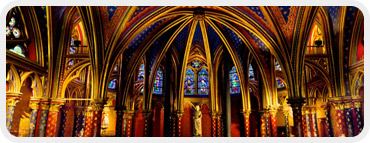
I really enjoyed this poem because I could relate to it very easily. The poem depicts an orchestra concert at Saint Chapelle, and because I play the violin, I can clearly picture this poem in my mind. The author, John Updike, starts by illustrating the scene of the concert with vivid details that allow the reader to picture the setting even if he or she has never been to Saint Chapelle. Updike continues on and describes the type of music being played. Vivaldi and Brahms were excellent choices for composers because they are both very well known and celebrated pieces of music, so it is easy for the audience to relate to them. Then, from here on, Updike describes the effect of the music, not on the audience but on the orchestra. The reader can infer this from the line "a glimmer ebbed until our beating hearts, our violins were cased in thin but solid sheets of lead." I really liked this part because I have experienced everything Updike describes. In fact, I have played pieces from both Brahms and Vivaldi and I can easily remember the feeling I got when I performed them. "[T'he listening eye saw suddenly the thick black lines , in shapes of shield and cross and strut and brace, that held the holy glowing fantasy together." This is my favorite part of the poem because there is a difference between playing notes on a page and actually creating music, and this part talks about the music jumping off the page and surrounding the orchestra. (picture: Saint Chapelle)
Sunday, September 19, 2010
The Halo That Would Not Light
So far, this is my favorite poem that I have read for poetry responses and that we have discussed as a class. It is haunting, powerful, and very moving. When I first read the poem, I was confused at what the author was writing about. Then, after reading it a few more times and with the help of the class discussion, I figured out that the poem was talking about a child who had died. I really like the beginning because it reminds me of the classic nursery story of babies being delivered by storks. "When, after many years, the raptor beak Let loose of you, He dropped your tiny body In the scarab colored hallow...." Where the raptor is the stork and instead of being dropped on a porch step, the child is dropped into a grave. My other favorite part was "Tonight the wind is hover- Hunting as the leather seats of swings go back And forth with no one in them...." This part was the most vivid for me because I remember loving to swing on the swings as child and when the author, Lucie Brock-Broido, talks about them being vacant, it really hit home. I also really loved the title: everyone says children are little angels, so The Halo That Would Not Light reminds me of a fallen angel, a child who never got to live.
Sunday, September 12, 2010
Lost Brother
When I first read this poem, I thought this guy was crazy, or at least that he was just another tree hugging hippie from Boulder, Colorado. He makes it sound like he thinks he is a tree, and that they both have the same mother. However, after reading it a several times more, I discovered that when he referred to "our mother" he was simply meaning mother nature.
I really liked the part when he "made up a story." The description the author uses to describe the scenery makes me feel like I'm in the mountains. I also enjoyed this part because it shows our inner child. It showed me that you are never to old to imagine even the wildest things, like being related to a tree.
"I am prepared to live as long as he did (it would please our mother) live with the clouds and those I love suffering with God." When I first read this last part I was extremely confused. I thought he meant he wanted to be immortal and live for "four thousand eight hundred sixty-two years" like his "lost brother," but then I looked a little deeper into the poem, and I discovered that maybe he did not mean literally living that long but figuratively. Maybe by living life to the fullest and trying to make a difference is the same if not better than living forever. I feel like this part teaches us that surrounding yourself with your loved ones and faith and shooting for the clouds would please "our mother."
I really liked the part when he "made up a story." The description the author uses to describe the scenery makes me feel like I'm in the mountains. I also enjoyed this part because it shows our inner child. It showed me that you are never to old to imagine even the wildest things, like being related to a tree.
"I am prepared to live as long as he did (it would please our mother) live with the clouds and those I love suffering with God." When I first read this last part I was extremely confused. I thought he meant he wanted to be immortal and live for "four thousand eight hundred sixty-two years" like his "lost brother," but then I looked a little deeper into the poem, and I discovered that maybe he did not mean literally living that long but figuratively. Maybe by living life to the fullest and trying to make a difference is the same if not better than living forever. I feel like this part teaches us that surrounding yourself with your loved ones and faith and shooting for the clouds would please "our mother."
Saturday, September 4, 2010
Mr. Fear
I really loved this poem because you didn't have to beat it with a hammer to understand its meaning; however, at the same time, you could look deeper into the poem and find an alternate meaning or another twist. When first reading the poem it appears that the author, Lawrence Raab, is talking about our fears appearing in our night mares. "Mr. Fear, we say in our dreams, what do you have for me tonight?" Then, later in in the poem the narrorator says, "Tell me, Mr. Fear, what must I carry away from your dream?" as if saying we create new fears in our dreams. However, after "beating the poem with a hammer" I felt like the real meaning f this poem was that our fears don't let us dream. They block out our good thoughts and fill our heads with terror. They don't allow us to have good dreams.
Subscribe to:
Posts (Atom)